

2025 TextielLab Annual Overview
28 February 2026
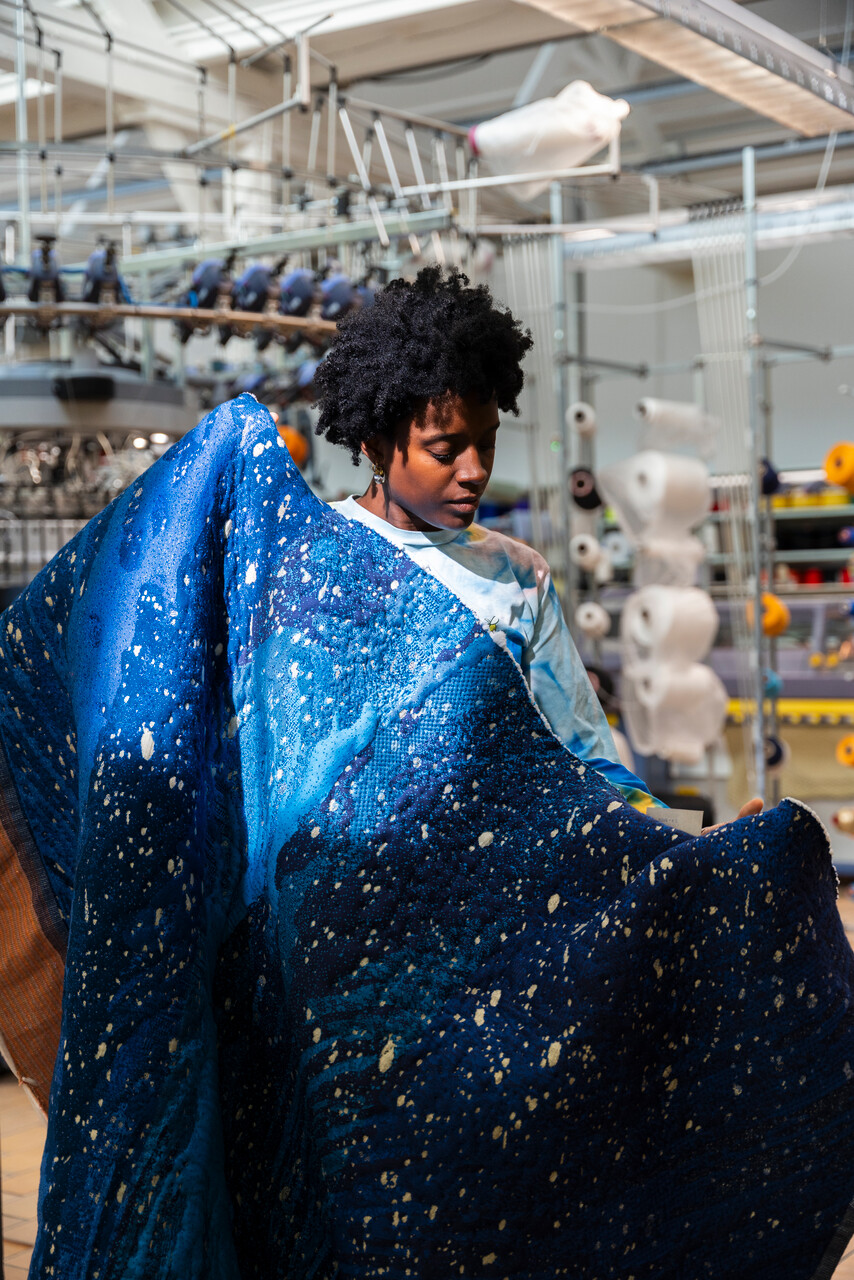
The TextielLab is increasingly positioning itself as an international platform in which sustainable collaborations take centre stage. Particularly notable is the rise in large-scale, spatial installations, in which textiles are more and more often employed as an architectural or scenographic medium. Examples include the large-scale set by Chloé Bensahel, where enormous curtains made of passementerie cords form the backdrop to a remarkable performance that tours the world. Or the colourful installation by Damien Ajavon for their solo exhibition at the Kunsthall in Oslo, in which they combine woven carpets with embroidered details and handmade fringes.
Sustainability is no longer a precondition, but an integral part of the development process. The sustainable table linen for by TextielMuseum, designed by Envisions, was woven from recycled workwear and equipped with a product passport that makes the material’s provenance transparent. The collaboration with Mae Engelgeer for TivoliVredenburg, for which no less than 700 m² of textile was woven from PET bottles, further underscores this development. In this way, we are not only a workshop within a museum, but also a driving force. Regarding subject matter, social themes such as climate change, colonial history, and identity come up frequently. Artists connect personal narratives to broader issues, with textiles functioning as carriers of meaning, memory, and dialogue. The collaborations commissioned by the museum, with Ayo, Sandim Mendes, and Ratri Notosudirdjo are exemplary in this respect.
Through dialogue with artists and designers, ideas were exchanged. A good example is the series of knowledge-sharing sessions on the possibilities of metal weaving, in which we explored new applications together with professionals from the field. These conversations generated fresh insights and formed the basis for the open call for a new phase of the R&D weaving programme focused on weaving with metal. This way of working highlights our role as a connective and research-oriented partner within the field.
At the TextielLab, we work not only with machines and materials, but above all with people. Each year, the number of interns learning with us grows, and the Advanced Textile Program becomes increasingly in-depth. In this way, those working at the TextielLab continue to learn themselves, while ensuring that knowledge and new perspectives are passed on to the next generation. The TextielMuseum’s Young Talent Platform also offers emerging talent the opportunity to present work created in the Lab to museum audiences, enabling them to gain experience not only in making, but also in exhibiting and articulating their work.
Finally, a look ahead. From 28 March 2026, the TextielMuseum will present ‘Man <3 Machine – 25 Years of TextielLab’. This exhibition marks a quarter century of the TextielLab and shows how textiles continue to innovate when human and machine reinforce one another. In the autumn, we will conclude with a symposium bringing together artists, designers, and industry partners to address questions that will shape the future of the field. And… a new weaving machine is on its way — more on that later this year.
Hebe Verstappen
Head of the TextielLab
Stay tuned
Where designers collaborate on innovation, there is a lot of news to get. Subscribe to the newsletter and get automatic updates on special projects, discoveries, events and open calls.
Share with friends