
The TextielLab goes sustainable | Jennifer Schmidt swaps polyester for wool
16 February 2026
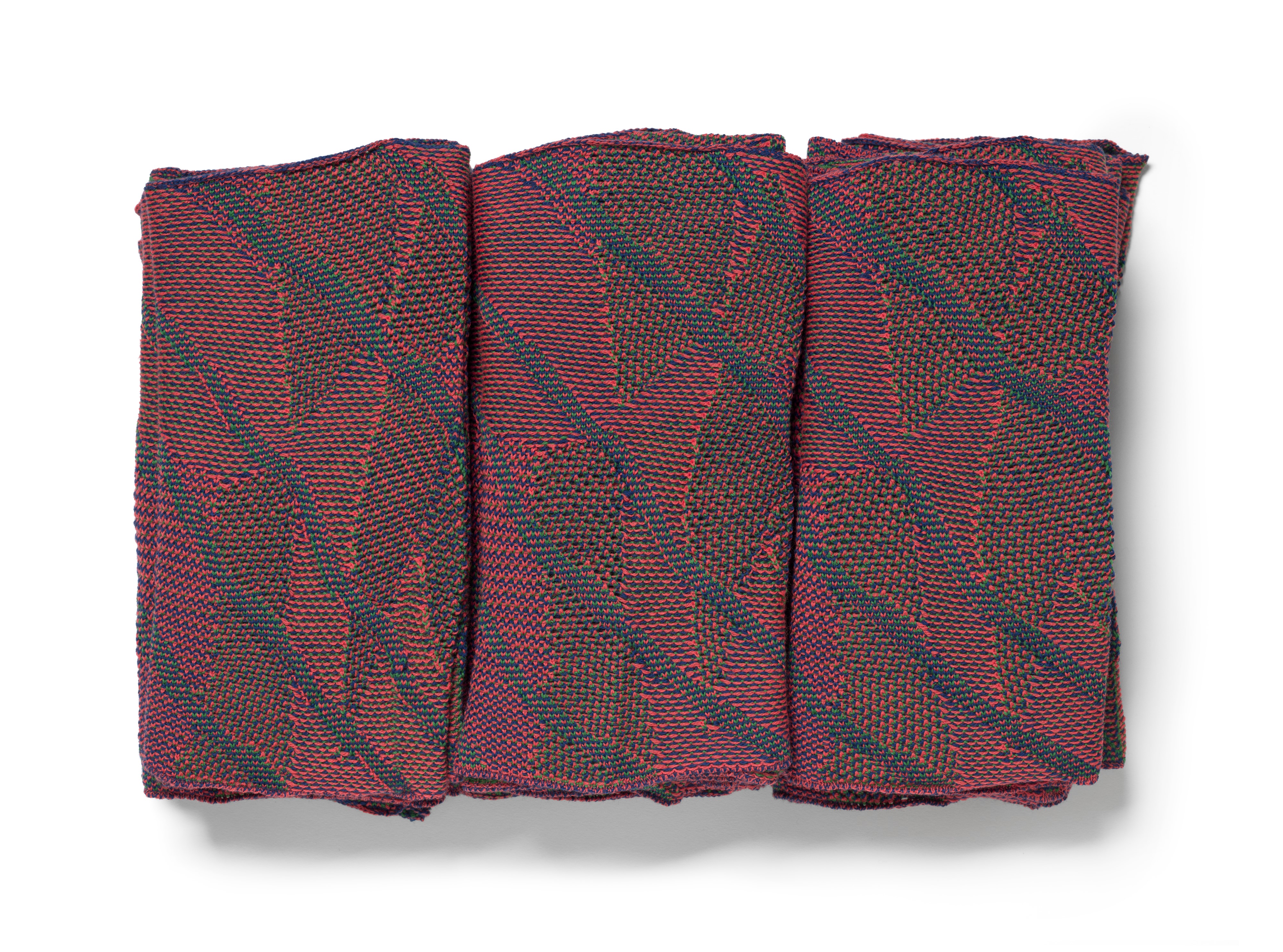
The TextielLab goes sustainable. This also means that the lab team aims to encourage artists to use more sustainable yarns. Jennifer Schmidt took this advice to heart, switching from glossy polyester to soft merino wool for a new edition of her For Clara scarf.
“Sustainability hadn’t really been a major theme in my work before, but through the process at the TextielLab, it has now become one,” says Jennifer Schmidt. She lives and works in New York as a multidisciplinary designer, but at the time of this interview, she was in Antwerp. There, she had just received her latest work from the lab – a sustainable wool edition of the For Clara scarf, which had previously been developed in the lab in a polyester and acrylic blend.
Clara Posnanski
It all began at the Art Institute of Chicago, where Schmidt became fascinated by the work of Clara Posnanski, who was part of the Wiener Werkstätte in the early 1900s. This relatively unknown female designer, like Schmidt, worked at the intersection of art, graphic design, and printing – she even had her own textile studio where she printed and finished fabrics. In the male-dominated world of printing, Schmidt found a female counterpart who shared her love of craft. Very little else is known about Clara Posnanski’s life and work; she vanished without a trace at the start of WWII. With the project ‘For Clara; shortcut on an extended plane’, Schmidt brings her name and work back into focus: “I am working on a continuum for Clara.”
Albert Cuyp
Inspired by one of Posnanski’s screen prints on textiles, Schmidt experimented with screen printing on fabric during an artist-in-residency at the AGA Lab in Amsterdam. Following Posnanski’s geometric patterns, she printed diagonal lines onto fabrics she bought at the Albert Cuyp Market. Schmidt shaped her continuum not only with a recurring pattern of these continuous “timelines,” but also by continuously introducing something new to the design. She scanned her screen-printed swatches for a sample book, which she brought to the TextielLab in 2023. Using these swatches as a foundation, she aimed to develop 3D-knitted objects, where the patterns would no longer sit on top of the fabric, but be integrated into it.
Glossy Blue
The digitally controlled knitting machines in the lab opened up a whole new territory for Schmidt, who had never developed her own textiles before. Together with product developer Yani Chuang, she spent three weeks refining the transition from flat prints to soft knitted art objects with a completely different structure, but a similar play of lines. To preserve the sharp screen-printed lines, they initially chose a glossy blue acrylic yarn combined with brightly coloured PET yarns.
From Art Object to Wearable
Recently, Schmidt submitted a new request to the lab for a variation of one of these objects, aiming to develop it from an art piece into a wearable cowl scarf. Product developer Yani Chuang and materials advisor Lise Brunt raised questions about the yarns used in the previous editions: “Even if you choose recycled PET yarn, it’s still a form of plastic,” says Brunt. “In our view, transitioning from art object to high-end wearable required a different material – one that not only suited the new application better, but was also more sustainable. The polyester from the earlier designs quickly pills and forms loops when worn, and microplastics can be released. That’s why we proposed making this new edition entirely from 100% merino wool from Italy. Wool is a natural, renewable material, it’s comfortable to wear, keeps you warm in winter, and stays beautiful for much longer. But using a different material does affect the final appearance, so there’s always the question of whether the lab should intervene – after all, it’s not our design.”
Microplastics
Schmidt welcomed the intervention: “That’s exactly why I enjoy working with the TextielLab – they are technically innovative and offer their expertise to help. I hadn’t considered it, but having microplastics so close to your face isn’t really a good idea.” She describes how switching from a manual printing press to a digital knitting machine brought unexpected surprises. “At the TextielLab, craft and art come together in a completely new way. I didn’t expect that with three yarn colours on the knitting machine, you could blend colours like in print. In the 100% wool scarf I unwrapped yesterday, the colours blend far more than in the polyester version. There’s only a blue, green, and orange thread, but now it also seems to include pink. That’s an unexpected bonus.”
Text by Willemijn de Jonge
Stay tuned
Where designers collaborate on innovation, there is a lot of news to get. Subscribe to the newsletter and get automatic updates on special projects, discoveries, events and open calls.
Share with friends