

Lisa Konno honours textile workers through new work
30 September 2026
The TextielMuseum commissioned Lisa Konno to develop a new work that honours and brings to light the stories of workers in Tilburg’s textile industry. To develop the work, the fashion designer is currently collaborating with knitting product developer Sarena Huizinga in the TextielLab. How did the initial idea come about, and what does the collaboration between Lisa and Sarena mean for the final work? Lisa: “Sarena also makes design choices when translating the concept into its execution on the knitting machine. And that’s how it should be: she knows the machine best.”
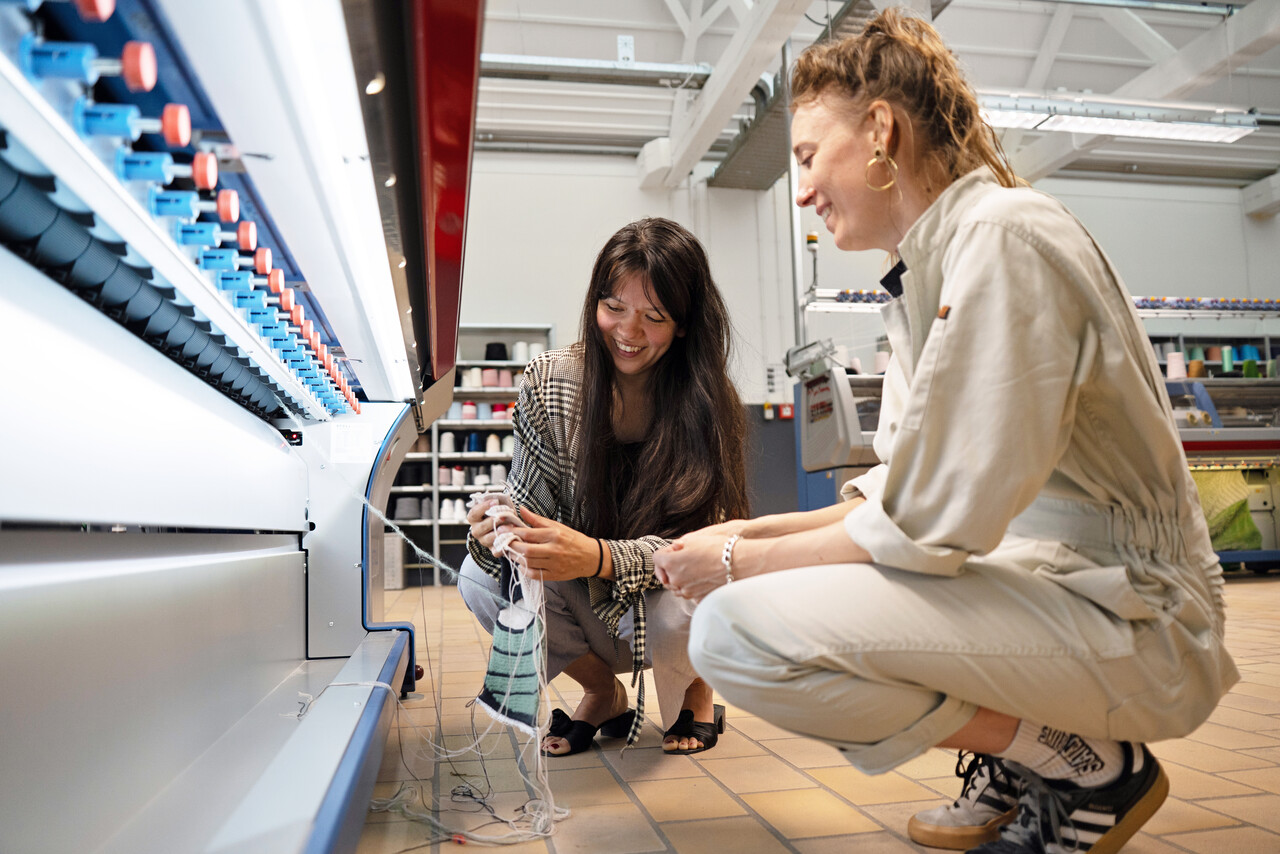
Photo by Joost van der Velden
A man wearing a pink karate suit, carrying a large fluorescent tube under his arm, walks slowly across the screen, with enormous paper cranes in the background. The same figure appears before and after him, creating the impression of an endless carousel. Meanwhile, he tells his story in English and Japanese: about moving to the Netherlands some fifty years ago, cultural differences and practical peculiarities (“The cucumbers were enormous here. And the courgettes too. It terrified me!”), and what life in the Netherlands has brought him.
NOBU is an interdisciplinary project Lisa Konno created with filmmaker Sarah Blok. Based on the story of her Japanese father, whom she interviews in the film, Lisa created a fashion collection that allows him to literally wear his own story. Together, Lisa and Sarah created a triptych, which also brings the stories of a Turkish immigrant (‘BABA’) and a Surinamese-Dutch man (‘HENK’) into the spotlight.
Lisa: “At the beginning of this year, Danique (Klijs, curator at the TextielMuseum, ed.) approached me and asked whether I could bring the story of Tilburg’s textile workers to life in a similar way, through an artistic installation.”
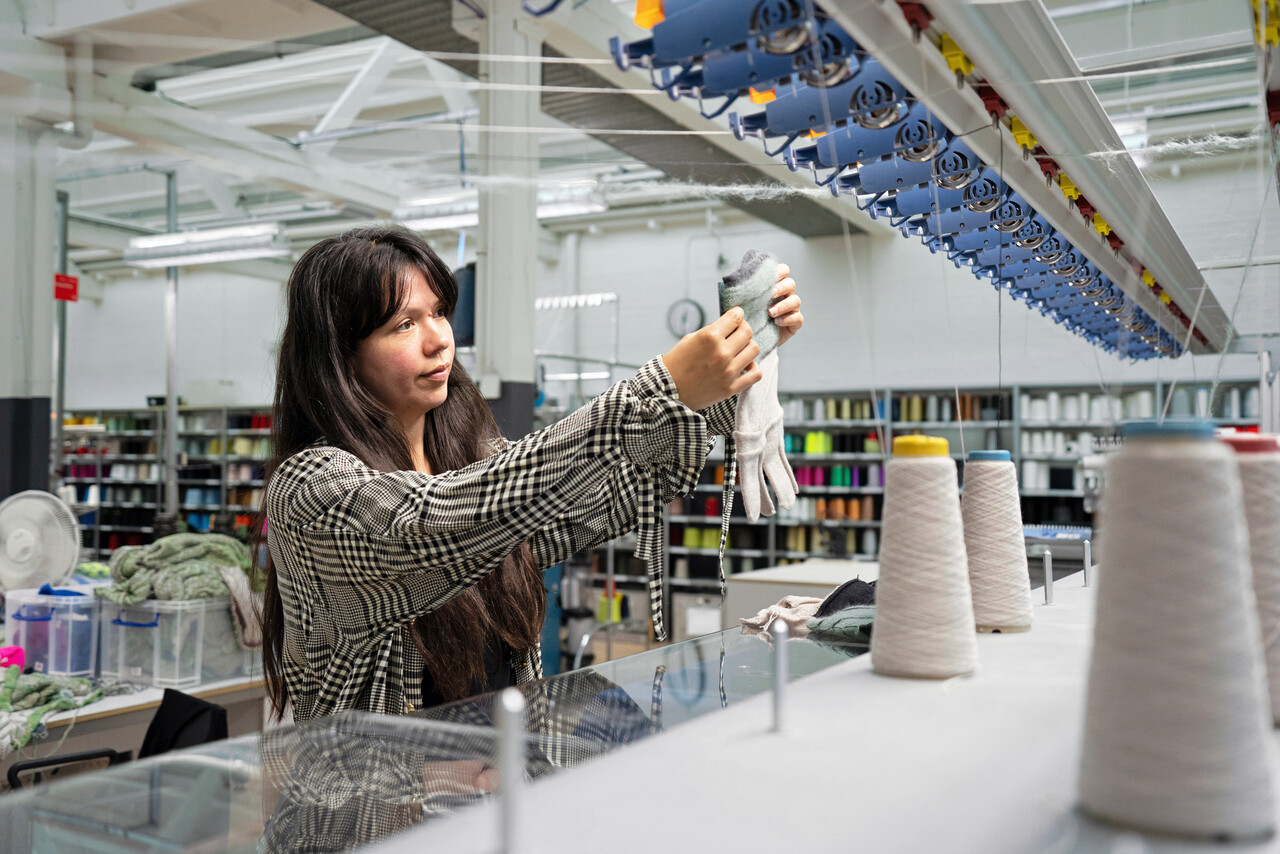
Photo by Joost van der Velden
Textile in your fingers
The question did not come out of nowhere. The TextielMuseum recently added twenty new stories from textile workers to its collection. These oral histories tell the stories of people who worked at well-known Tilburg factories such as J. Brouwers Lakenfabrieken, Koninklijke AaBe Wollenstoffen- en wollendekenfabrieken, De Regenboog, H.F.C. Enneking and Pieter van Dooren.
The project is part of a pilot exploring the history of the textile industry in Twente and Tilburg by the Oral History Network ‘Sprekende geschiedenis’.
Lisa: “I listened to all of the stories. They gave me a glimpse into the human side of the textile industry: how did people experience their work here? And what did it mean to them when the industry eventually moved away from Tilburg?”
She kept returning to the hands of these workers.
“Of course, they worked in factories. But so much of the work was still done by hand. Over all those years, those hands experienced an incredible amount; kilometres of fabric passed through their fingers,” she explains. “But weaving, knitting or darning also became second nature to them. You cannot pass that kind of knowledge on through a book; you only acquire it through years of working with your hands.”
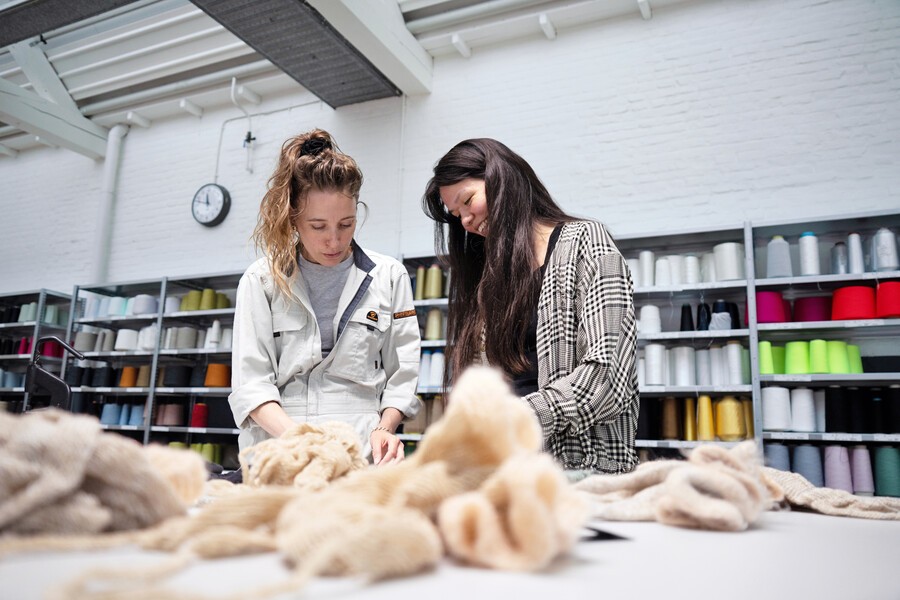
Photo by Joost van der Velden
Raw beauty
Lisa was paired with Sarena, with whom she had previously collaborated in the TextielLab, and the collaboration had already proved successful.
Lisa: “I knew quite quickly that I wanted to capture the stories in the form of gloves. And for a glove like that, knitting works best. You can take a glove off the knitting machine in one piece, which looks the most beautiful. Knitted fabric is also much more stretchy than, for example, woven fabric, which makes it better suited to achieving the right fit.”
For this work, Lisa wants to bring out a particular contrast: on the one hand, the roughness of work gloves and working hands; on the other, a sense of refinement, referring to the beautiful cloth, jacquards, suits and blankets produced by textile workers.
Lisa: “The conditions they worked in were tough, although the factories often also created a strong sense of togetherness. But what the men and women produced was often beautiful and refined. Both sides need to be present in the final gloves.”
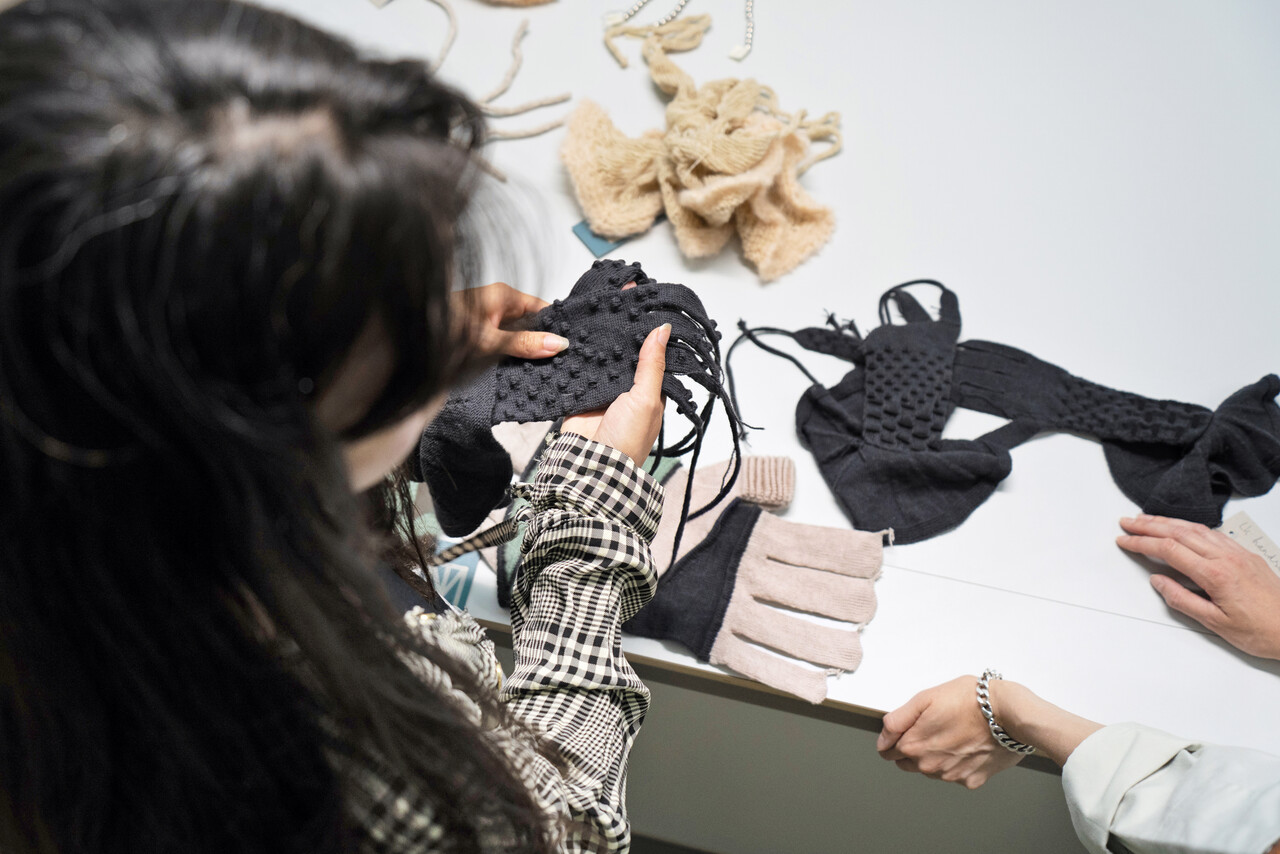
In the TextielLab, Sarena shows the first samples: refined, almost delicate white and black gloves reminiscent of the elegant gloves worn by stylish women in the 1950s. But appearances can be deceptive, Sarena explains, pointing to the raised structure on the back and palm of the gloves.
“This refers to the roughness of the work and what it did to the workers’ hands, in the form of calluses and scars.”
Another glove has a jute-like appearance. It is made from yarn containing human hair.
Sarena: “We liked that rough quality, but the glove needed to be narrower. Our idea was that washing the glove would make it shrink.”
They knew beforehand that washing it would cause the material to felt. Even so, it did not produce the desired result.
Lisa: “Now it looks fluffy and rather wintry. The look no longer fitted with the direction I had in mind. But that’s not a problem: trying things out like this is part of the development process for me.”
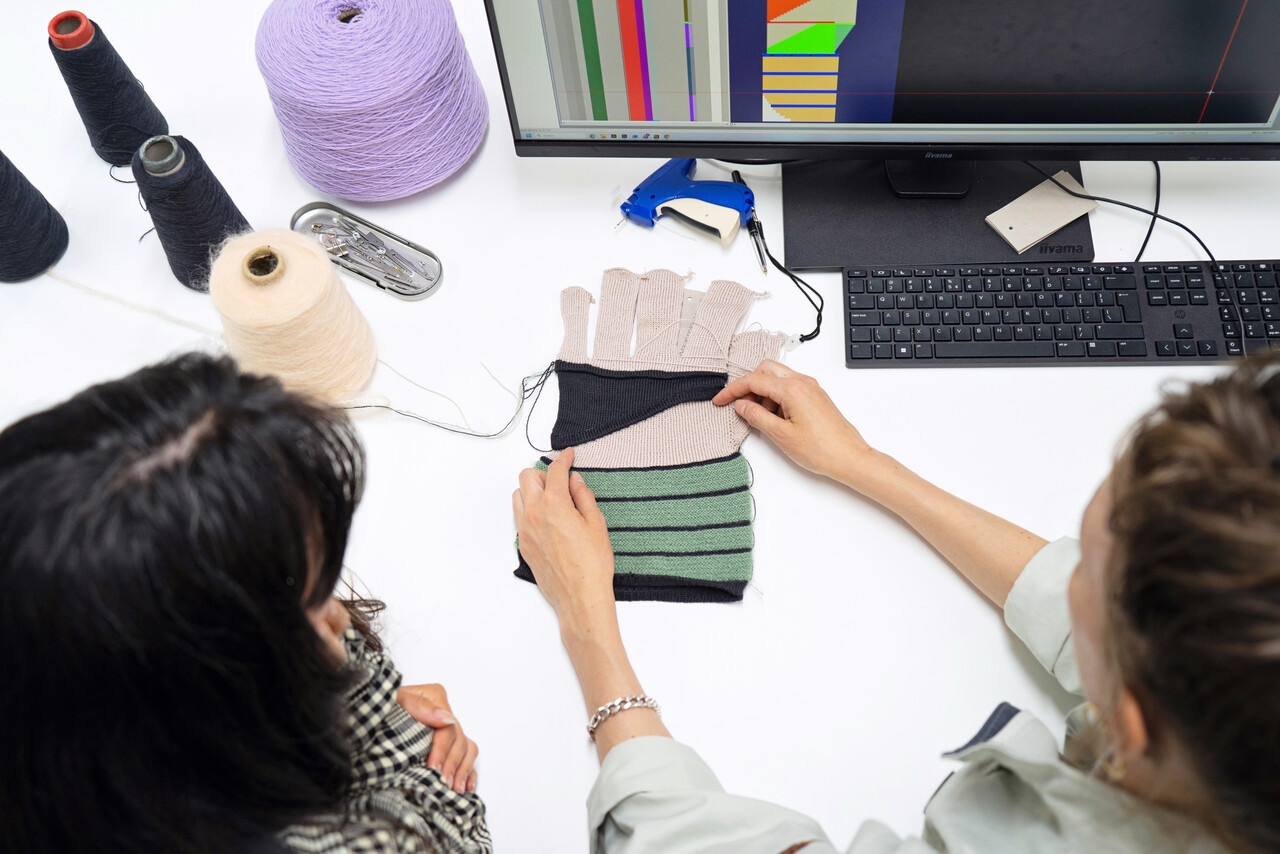
Photo by Joost van der Velden
A strong collaboration
Developing the work is a back-and-forth between Lisa and the specialists in the TextielLab. Yarn specialist Lise Brunt, for example, carried out extensive research into suitable yarns that also connected with the concept on a conceptual level.
For Lisa, this meant Dutch yarns made from natural materials, with wool at the centre – after all, Tilburg was once a major wool-producing city.
Sarena: “I already knew that we shouldn’t attempt anything technically complicated with the yarn containing human hair: it would break. The same applied to the recycled yarn. I could immediately see that it was too fragile for the application we had in mind.”
When it comes to translating her design into something that can be made on the machine, Lisa places complete trust in Sarena. And she has to: the programming language of the knitting machine is impossible for an outsider to understand.
Lisa: “Sarena makes design choices when translating the concept into its execution on the knitting machine. She has to; she knows exactly what will and won’t work. Just look at the ballet costume we developed together last year. There’s a kind of ‘swoosh’ in it that works incredibly well. Sarena created that. I couldn’t have come up with it myself.”
Sarena: “I think that’s where the strength of the collaboration lies: Lisa creates a design in her studio and together we get everything out of it that it has to offer. We combine our strengths to achieve the best possible result: a strong story that is technically and aesthetically satisfying, as well as innovative.”
The development of this work was still fully underway at the time of the interview. From April 2027, the work will be on display at the TextielMuseum as part of an exhibition about the wool industry.
Written by Iris van den Boezem.
Stay tuned
Where designers collaborate on innovation, there is a lot of news to get. Subscribe to the newsletter and get automatic updates on special projects, discoveries, events and open calls.
Share with friends