

.jpg)
Project Space: an intimate glimpse into the artist's mind
13 July 2026
At the heart of the TextielMuseum lies the TextielLab: the place where artists and designers collaborate with textile specialists to shape the future of textiles. Walk through the lab and you'll immediately sense its energy. Machines rumble, whirr and thump; the scent of machinery lingers in the air, while a vibrant palette of coloured yarns sparks the imagination.
Yet until recently, the true essence of the TextielLab – the countless hours of experimenting, testing and refining ideas – remained largely hidden from museum visitors. Project Space changes that. The exhibition currently offers an intimate look into the creative processes of artist-designers Simone Post and Kiki van Eijk.
Kiki van Eijk is renowned for her distinctive design practice, from her embroidered clocks and chair paying tribute to Martin Visser to her many vases and lighting designs. Alongside her design work, she also creates autonomous artworks, often with textiles at their core. It is therefore no surprise that she has collaborated with the TextielLab on numerous occasions. Over the past year, she has been working here on her latest series of woven wall hangings.
A closer look into the creative process
At the heart of the TextielMuseum lies the TextielLab: the place where artists and designers collaborate with textile specialists to shape the future of textiles. Walk through the lab and you'll immediately sense its energy. Machines rumble, whirr and thump; the scent of machinery lingers in the air, while a vibrant palette of coloured yarns sparks the imagination.
Yet until recently, the true essence of the TextielLab – the countless hours of experimenting, testing and refining ideas – remained largely hidden from museum visitors. Project Space changes that. The exhibition currently offers an intimate look into the creative processes of artist-designers Simone Post and Kiki van Eijk.
Kiki van Eijk is renowned for her distinctive design practice, from her embroidered clocks and chair paying tribute to Martin Visser to her many vases and lighting designs. Alongside her design work, she also creates autonomous artworks, often with textiles at their core. It is therefore no surprise that she has collaborated with the TextielLab on numerous occasions. Over the past year, she has been working here on her latest series of woven wall hangings.
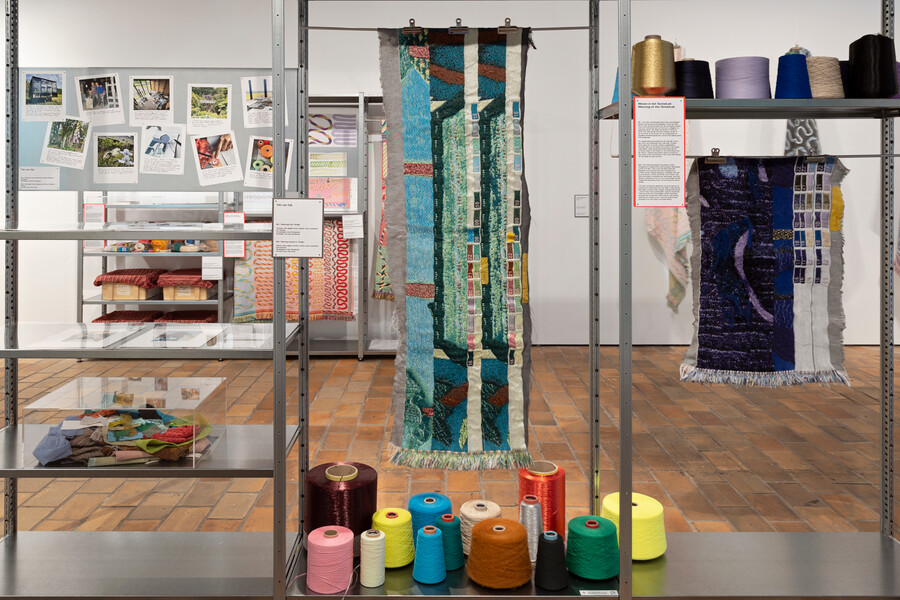
Photo by Josefina Eikenaar
From watercolour to woven wall hanging
The display dedicated to Kiki van Eijk reveals how her creative process began with a series of watercolours, painted during a short residency with artist Marc Mulders at Landgoed Baest in Oirschot. She then translated these paintings into collages using fabric from her extensive textile archive.
Danique points to a collage featuring a wooden boardwalk. “Here you can see how Kiki interpreted the tree canopy using soft pink lace,” she explains. “Around the boardwalk, she experimented with entirely different textures.” Turning towards the finished wall hangings, she continues: “Those collages and textures were then translated into woven textiles here in the TextielLab. Can you see it? Normally, this essential stage of the creative process remains hidden from visitors.”
Viewed from a slight distance, the wall hangings almost resemble real collages. They appear layered, as though pieces of fabric overlap to create depth, echoing Kiki's original small-scale designs.
“That effect comes from the weaving technique itself,” says Danique. “It's achieved through the combination of weave structures, material choices and colour. Just as a painter mixes pigments, Kiki and Lotte carefully developed colours together. Except, of course, yarns don't actually blend. It's an optical illusion, and a remarkable one. It perfectly illustrates the close collaboration between Kiki and the textile specialists in our lab.”
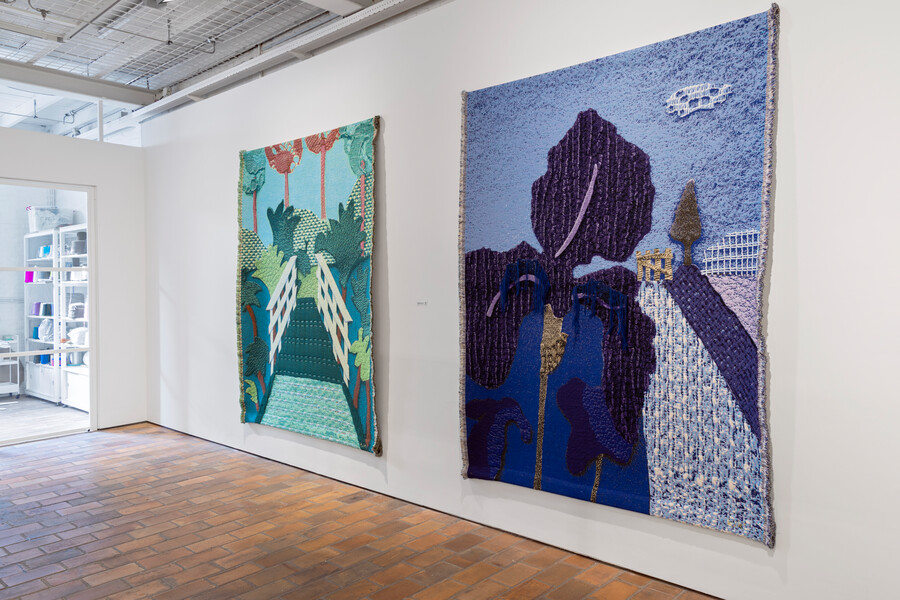
Photo by Josefina Eikenaar
A tribute to grandmother, mother and the beauty of textiles
On the opposite side of the gallery is the work of Simone Post: one woven wall hanging and three blankets developed in the TextielLab. Together, they form a tribute to her grandmother and mother, and to the textile skills they passed down through generations.
Their presence is felt throughout the exhibition. One display includes an old mustard-yellow storage box that belonged to Simone's grandmother, alongside vintage balls of HEMA yarn — complete with the memorable slogan 'Unused? Money back!' — and the plastic crates in which she kept her fabrics and sewing materials.
“From the moment you see these objects, it's clear how personal this project is,” Danique explains. “There's a photograph of Simone's grandmother here, and another of her mother.”
Traditional textile skills are gradually disappearing, even though making and repairing clothes was once an everyday part of life.
“Simone celebrates the beauty of textiles and yarn, but she also invites us to reflect,” says Danique. “Once you realise how much time, knowledge and craftsmanship go into producing textiles, you may think twice before buying fast fashion.”
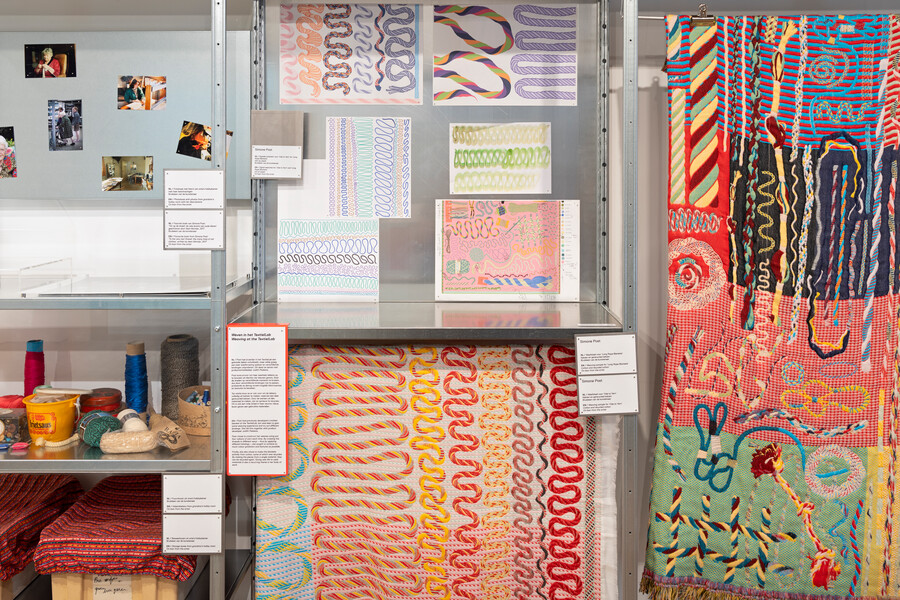
Photo by Josefina Eikenaar
One of the greatest technical challenges behind Simone's work stemmed from a restriction she imposed on herself. She wanted to create the widest possible colour palette using only four different yarns.
“Imagine combining red and white,” Danique explains. “If you alternate the warp and weft threads, you'll achieve a completely different shade of red than if you weave several white threads before introducing a single red one. Exploring how colour, weave structure and different yarns interact is exactly the kind of research our product specialists undertake together with artists.”
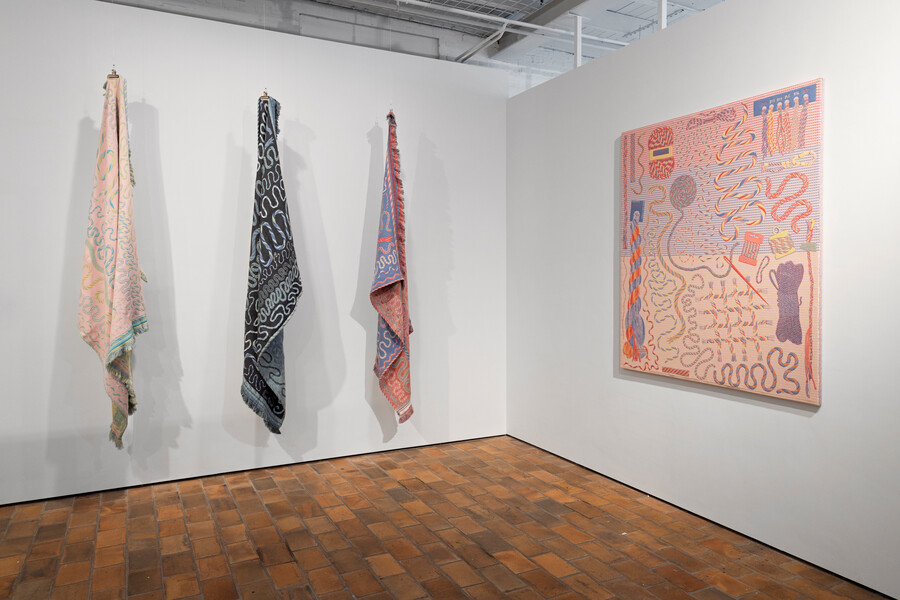
Photo by Josefina Eikenaar
Simone Post on exhibiting in the Project Space
“Textiles have become disposable,” says Simone Post. “We buy them and throw them away almost without thinking. I think that's a shame, because making textiles is both an intensive and an extraordinary process. We've largely lost sight of that today.
For my mother and grandmother, things were different. They worked with textiles themselves, so they understood just how complex and fascinating the process really is. I'd love to see that appreciation return. That's why I created An Ode to Yarn — my personal tribute to textiles.
Of course, it's quite intimate to have my grandmother's personal belongings and family photographs displayed in a museum. But I've noticed that visitors often recognise them and say, 'My grandmother had things just like these.' I hope this exhibition encourages people to see textiles in a new light and to value them more, just as my grandmother, my mother and I have always done.
Showing this work at the TextielMuseum makes it even more meaningful. My grandmother lived in Tilburg, and my grandfather built a loom for my mother based on one in this museum. In many ways, this exhibition brings the story full circle.”
Stepping inside the artist's mind
Through Project Space, Danique hopes to bring visitors closer to the artists working in the TextielLab.
“It's a rare privilege to gain such an intimate understanding of these artists and to discover how their work comes into being. You begin to see how much research, experimentation and perseverance lie behind every finished piece.
I hope visitors leave with a new appreciation for textiles — not only the artworks in our collection and exhibitions, but also the textiles they encounter every day. They're far more than everyday objects. A visit to Project Space makes that immediately clear.”
Written by Iris van den Boezem
Stay tuned
Where designers collaborate on innovation, there is a lot of news to get. Subscribe to the newsletter and get automatic updates on special projects, discoveries, events and open calls.
Share with friends