

Pushing artistic boundaries through knitting
25 August 2026
Knitting and weaving each have their own qualities. Yet knitting as an innovative option for textile designs and artworks remains relatively unfamiliar to makers, brands and product developers Sarena Huizinga and Mathilde Vandenbussche. And that is a shame. Mathilde: “A collar, a costume, a wall hanging: with knitting, you can make it all in one piece, so there is no need for any construction afterwards.”
Sarena Huizinga (left) and Mathilde Vandenbussche in the TextielLab. Photo by Roxanne van de Zanden.
It is a peculiar combination of a cape with a hood and a long train. The colours, protrusions and structures bring to mind internal organs or alien-like figures. Sarena laughs: “The Belgian designer Elmo Mistiaen came here with AI-generated images and said: this is what I want to make. At first, I thought: how on earth? But that kind of challenge is exactly what I love getting stuck into: I keep going until I make it work.” And take note: the protrusions, ridges and blobs – everything on this cape, both large and small – came straight out of the flat knitting machine in one piece. They were not sewn on afterwards. Mathilde jokes: “We knitters are a little lazy. If you can get it out of the machine in one piece, why would I sew it on afterwards?” She continues: “Besides, a knitted piece made in one go simply looks so much better. It’s quality; an expert can see that immediately.”
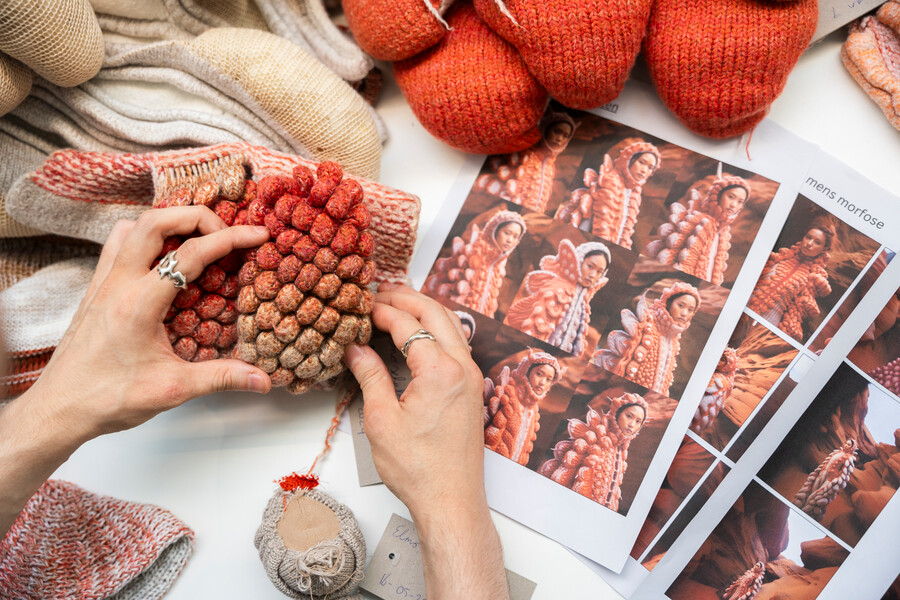
Samples and design by Elmo Mistiaen. Photo by Patty van den Elshout.
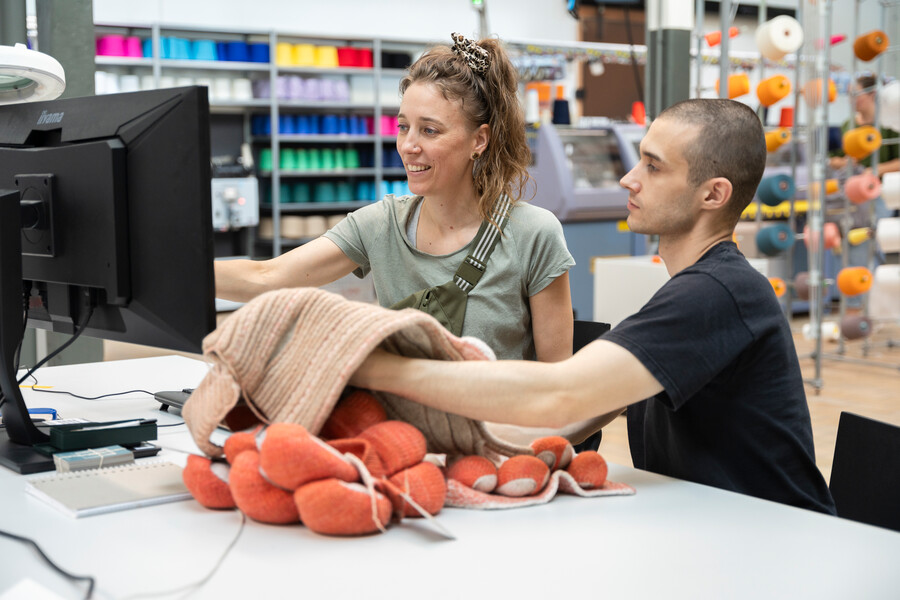
Sarena Huizinga (left) and Elmo Mistiaen. Photo by Patty van den Elshout.
Nerds with an artistic eye
The TextielLab houses three computer-controlled Stoll flat knitting machines, with widths of 72 or 86 inches. The number of needles per bed ranges from 419 to as many as 1,203, allowing both coarse and highly refined fabrics to be knitted. These machines can do a great deal: from fabric by the metre to 3D objects such as the example above. Sarena and her colleagues programme makers’ designs using M1Plus software. Sarena: “It helps that, as product developers, we are all makers ourselves. That means we can support the makers who come here in achieving the result they are looking for, advising them on colour, materials and technical possibilities, for example.” Mathilde: “And at the same time, not everyone can do the programming. You do have to be a bit of a nerd. Nerds with an artistic eye – that is perhaps the best way to describe our profile.”
Sarena specialises in 3D knitting, something she also practises as a maker herself. “You have to make a translation: from a two-dimensional design to a three-dimensional interpretation on the knitting machine. That is complex,” she explains. You can compare a flat knitting machine to a 3D printer, as you are essentially knitting layers on top of one another. Sarena: “But knowing how to programme that properly requires technical knowledge. And it is a matter of trying, trying and trying again.” Mathilde: “Knitting is a technique where, when you make a test swatch, the result can be completely different from what you expected. The material you work with can shrink, contract or stretch. Often, that is precisely what leads to the most interesting discoveries.”
The secret of the circular knitting machine
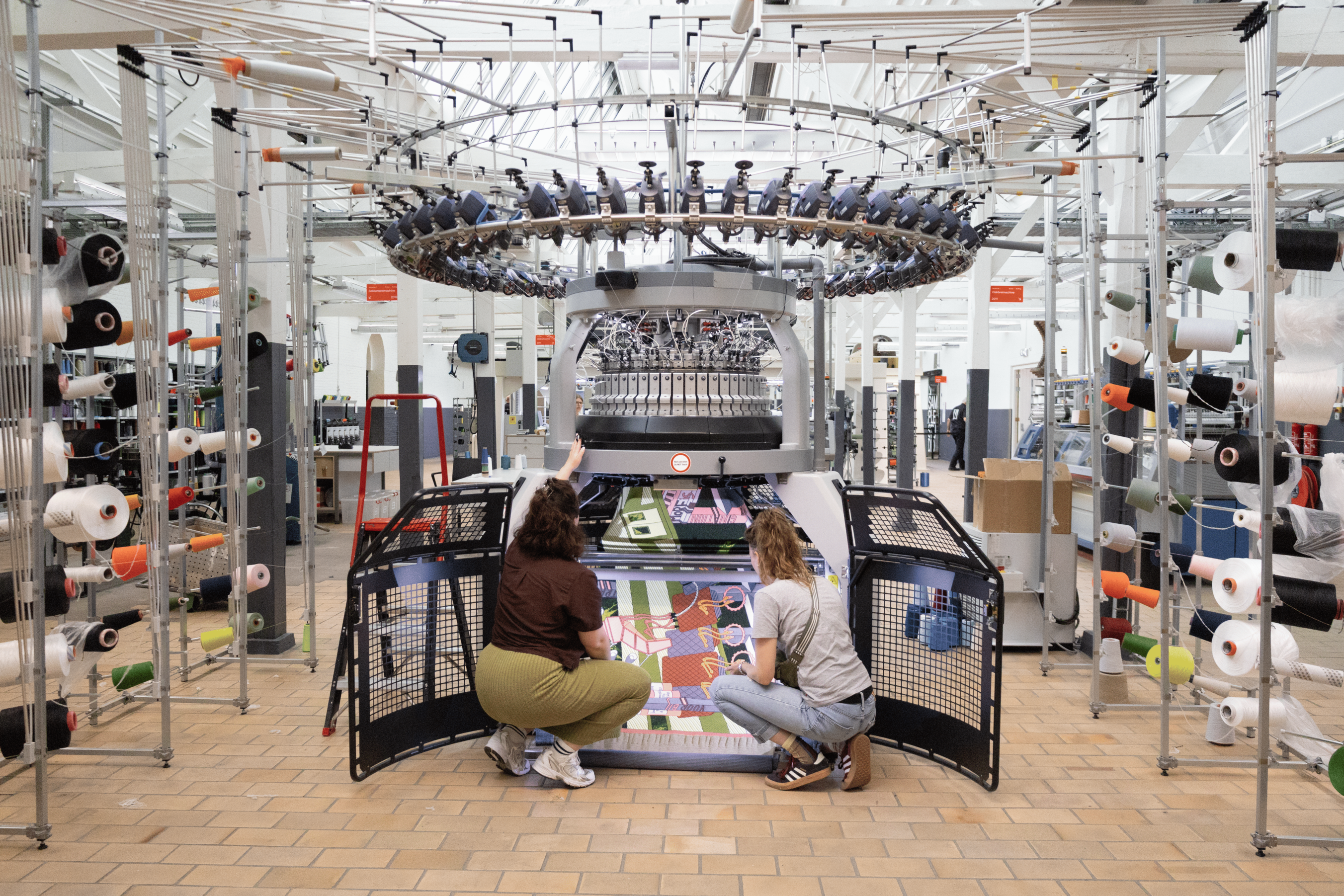
There is also a circular knitting machine in the TextielLab: an impressive piece of equipment with no fewer than 1,440 needles, making the finest stitches of all the knitting machines in the lab. Let’s clear up a persistent misconception straight away: it is not the case that you can only knit hollow forms such as scarves and socks on this machine. Mathilde: “The knitted fabric does indeed come out as a long tube. But we usually cut the tube open, and then you have a flat knitted fabric.” The machine produces jacquard or double-layer knitted fabrics: in the former, the pattern is knitted directly into the fabric; in the latter, the fabric consists of two layers joined together, both of which have a neat finish on either side. Mathilde: “With this machine, you can produce a large knitted piece very quickly, much faster than on a weaving machine, for example, while still working with an incredible level of detail. And what comes out of the machine is immediately of a high quality. It’s no coincidence that I enjoy working with this machine so much.”
Here too, the works are developed through co-creation between the maker and the product developer, such as Mathilde. “For an average final piece, we usually make around five metres of test swatches, because we constantly need to test whether what we have conceived will actually produce the desired result.”
Mathilde works with established artists such as Danish artist Henrik Vibskov, but also with students. She shows a photograph of a wall hanging she recently developed together with Pam Werlotte, a student at HKU University of the Arts Utrecht. “Pam had spent two months working continuously on this illustration. She knew she wanted to do something with textiles, but not exactly what. So, step by step, we looked at what we could do. Which colour combinations would work? Which yarns?”
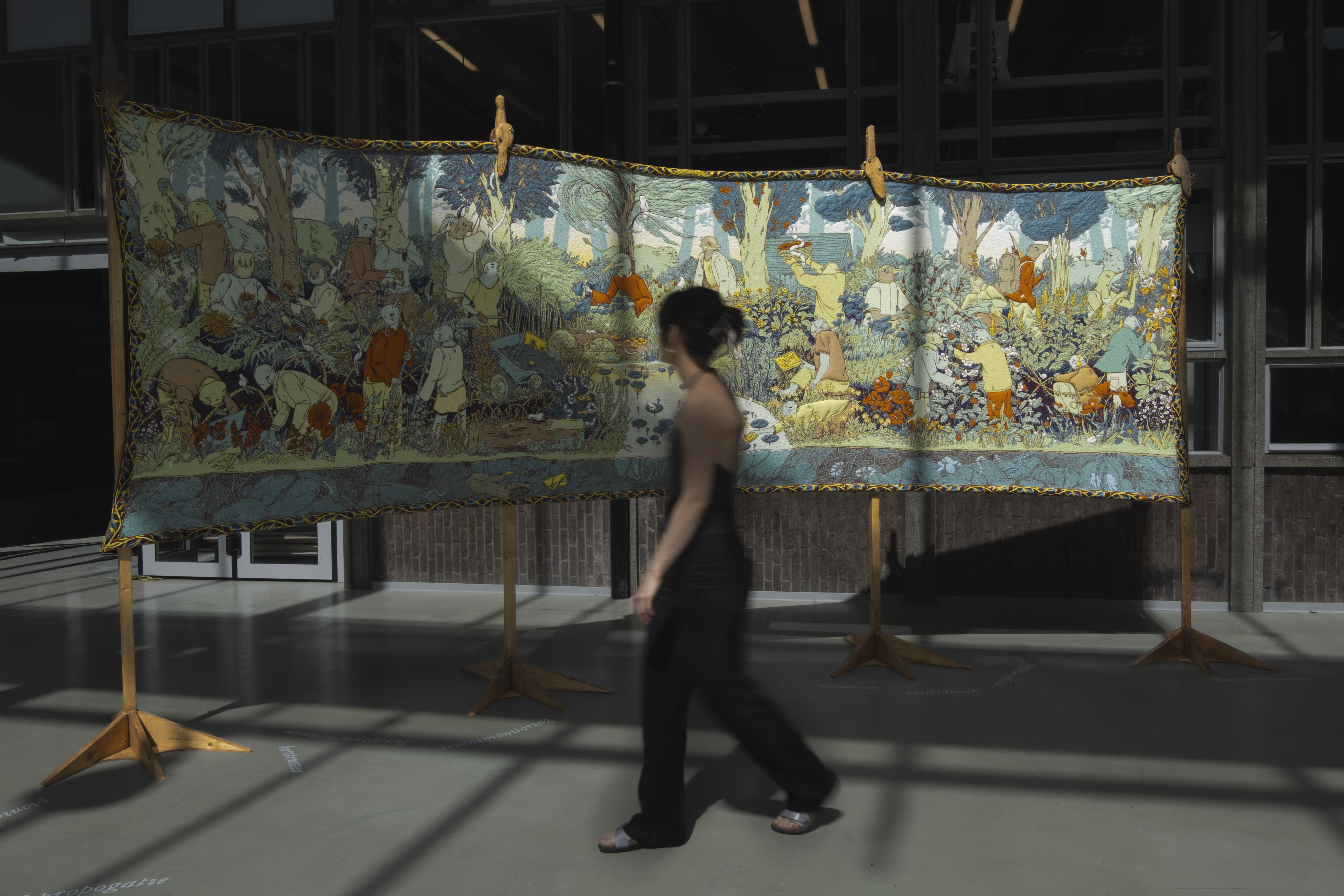
Wall hanging by Pam Werlotte. Photo by Annika Felder.
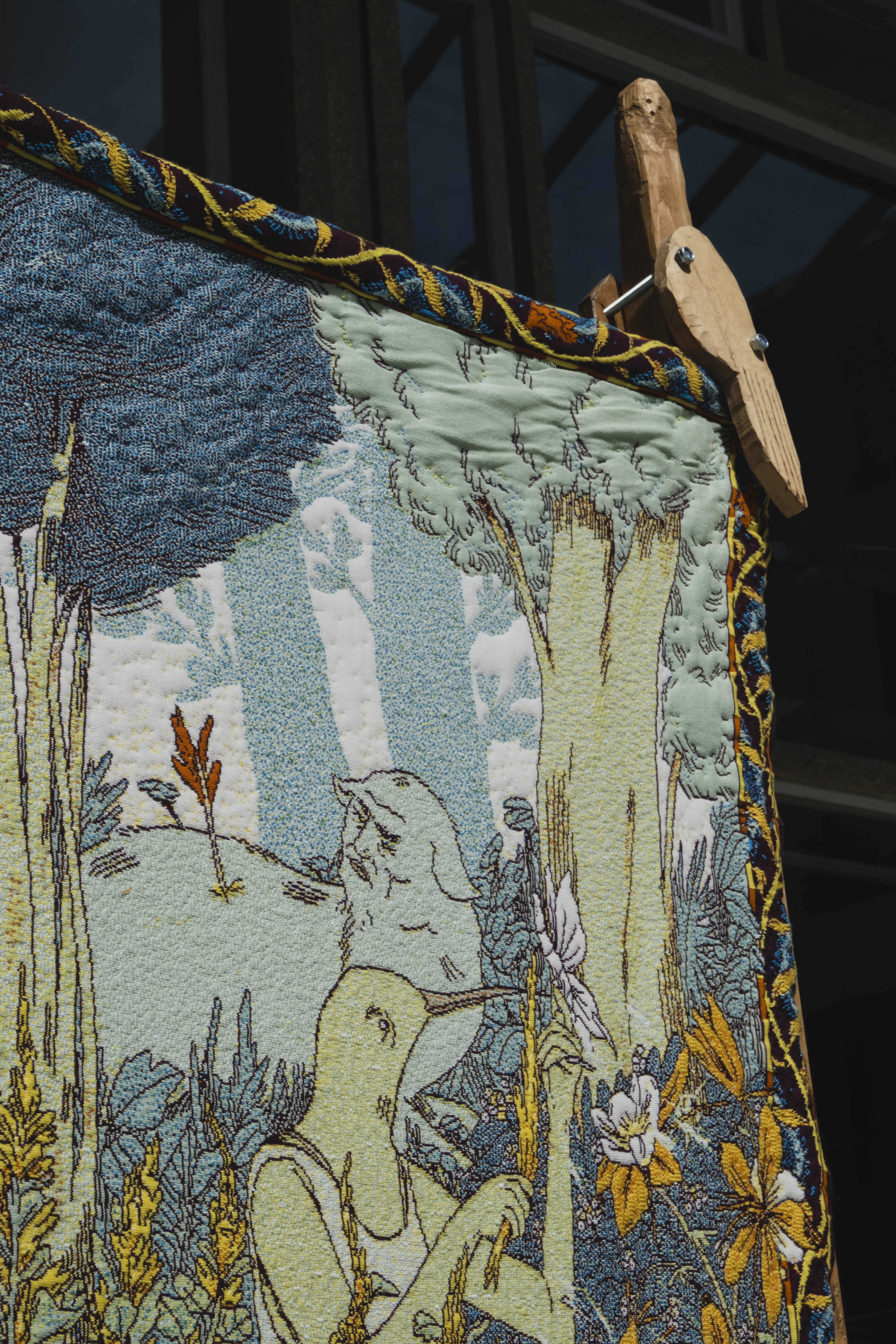
Detail wall hanging by Pam Werlotte. Photo by Annika Felder.
Mathilde points to a test swatch. “If you look at this section from a distance, it appears to be a particular shade of orange. But when you stand right next to it, you suddenly see that it is a combination of specific shades of red and yellow, which we blended together in the knit.” The product developers help makers figure out how to create this kind of blending. Mathilde: “You are not actually mixing the yarns; it is an optical illusion. But it has an enormous effect on the atmosphere of a piece.”
Leaving the comfort zone behind
Knitting is a centuries-old technique. Many people may still hear the rhythmic clicking of their mother’s or grandmother’s knitting needles in the back of their minds. So, is innovation possible with something that has been around for so long? Sarena: “Yes, absolutely. Just look at Elmo’s work. It is miles away from that itchy jumper your grandmother used to knit.”
Mathilde: “Knitting as a technique is constantly evolving. The artists who work here push us beyond our comfort zone with their ideas. And we do the same for them. Knitting is an incredibly versatile technique. We warmly invite makers to push those boundaries even further with us. We would love nothing more.”
Written by Iris van den Boezem
Stay tuned
Where designers collaborate on innovation, there is a lot of news to get. Subscribe to the newsletter and get automatic updates on special projects, discoveries, events and open calls.
Share with friends