


Threads of Innovation Symposium: A Celebration of Innovation
16 October 2026
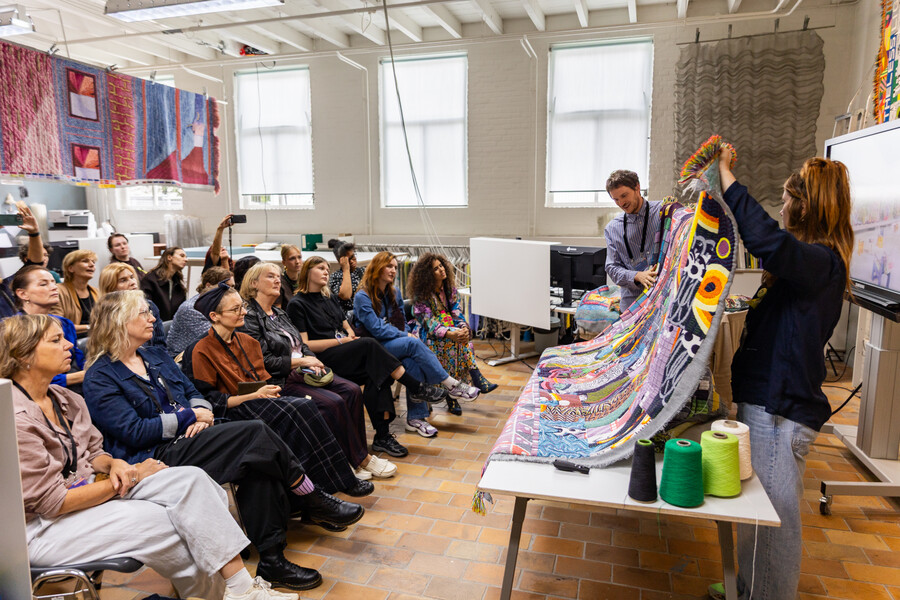
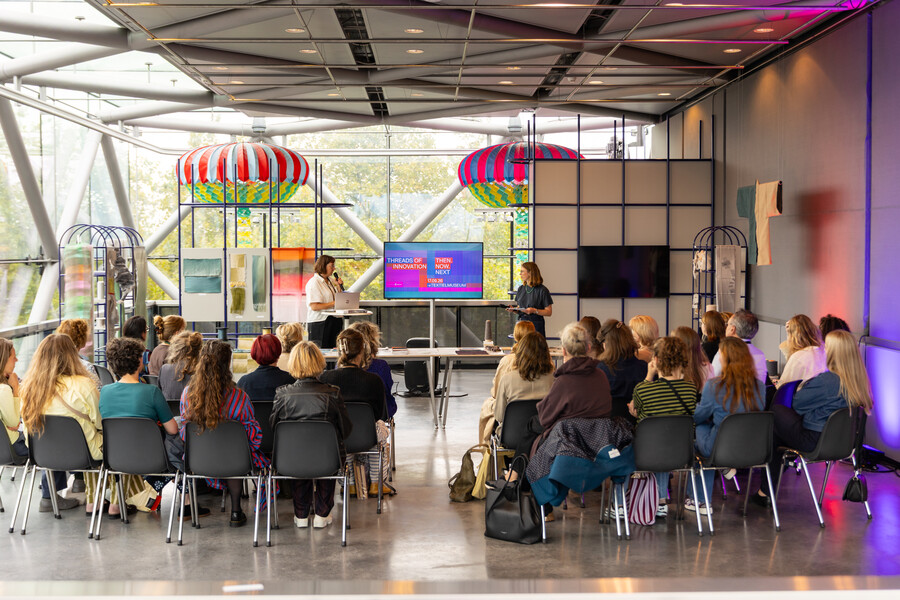
On Thursday 17 September, TextielMuseum | TextielLab welcomed a colourful crowd. Artists, designers, manufacturers, students, educators, curators and textile enthusiasts came together for Threads of Innovation, the biennial symposium exploring the future of textiles.
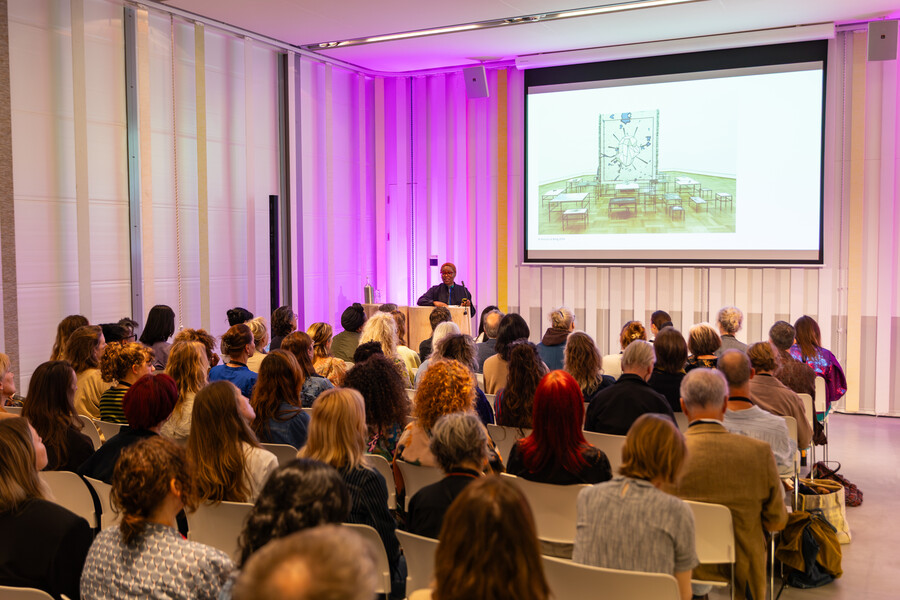
‘Place your feet firmly on the ground, with your hands on your thighs. And let’s take one breath in and out together. Breathe in…’ says renowned textile artist Otobong Nkanga to the audience. ‘And let go.’ Shoulders relax throughout the room, a sigh escapes here and there, and the rush of the early morning begins to fade. It is the perfect start to Threads of Innovation, following a warm welcome from Hebe Verstappen (Head of TextielLab) and moderator Maaike Muis. Nkanga is the first of no fewer than five keynote speakers at the symposium, which is once again completely sold out, just as it was two years ago. English is the official language of the event, and for good reason: many participants have travelled from outside the Netherlands. The international character of the symposium is also reflected in the large number of people following the latest developments in textiles online and from afar.
Imagining a dream
Nkanga gazes around the bright lecture hall on the second floor of TextielMuseum. She smiles. ‘To weave a dream. Everything starts with a dream, literally or figuratively.’ Nkanga has an impressive track record. This year, she received the Sikkens Prize for her groundbreaking use of colour, and her work has been exhibited all over the world.
During the symposium, she speaks, among other things, about the exhibition Unearthed, through which she transformed all four floors of Kunsthaus Bregenz into landscapes in 2021–2022. ‘It’s not just about the work itself. The light and airflow in a space are also hugely important,’ she explains. ‘I want the interaction between the visitor and my work to be as effective as possible.’
Nkanga’s work explores our relationship with the earth and what happens when we use up and exhaust its natural resources. She has collaborated on several occasions with TextielLab product developer Stef Miero. ‘Over the years, we’ve developed our own language,’ she says of their long-standing partnership. This is particularly important for her work, where achieving the right balance between materials, colour and weaving techniques is crucial. Only then can the work convey the story as the artist intended. ‘How do you imagine a dream?’ she asks aloud. ‘You need other people to do that.’
Textiles as storytellers
Stories woven into textiles are also a recurring theme for the second keynote speaker. Jessica Hemmings is a British writer and professor at the University of Gothenburg and the Oslo School of Architecture and Design. She is also a visiting lecturer at the Moholy-Nagy University of Art and Design in Budapest and spent three years as a Rita Bolland Fellow at the Research Centre for Material Culture in Leiden.
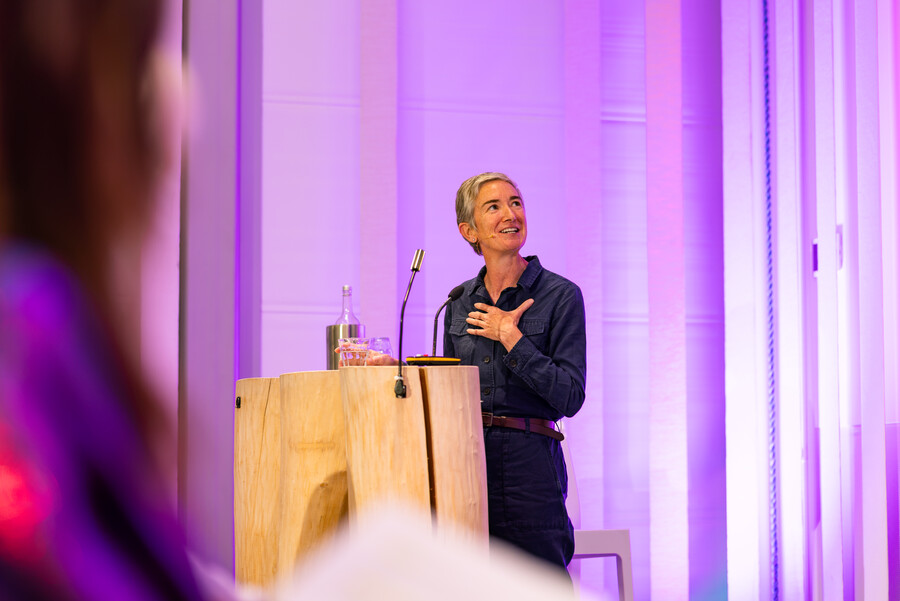
‘Textiles contain hidden stories,’ she explains. ‘They reveal different origins, backgrounds and political circumstances.’ Hemmings points to recent work by visual artist Oscar Lara. Together with Swedish researchers, including Hemmings, and textile makers, Lara meticulously recreated Paracas textiles that had been looted from Peru by Swedish diplomats in the 1930s. He reproduced the original techniques and materials as accurately as possible, while the original Paracas textiles were gradually returned to Peru.
‘Textiles are not simply functional objects or works of art,’ says Hemmings. ‘They offer a kaleidoscope of perspectives that we must continue to share, listen to and investigate.’
Building with textiles
‘The places we inhabit and work in affect our bodies, our minds and our emotions.’ In TextielMuseum’s contemporary lecture hall, a ray of sunlight gently filters through the tall windows. The third keynote speaker is Crystal Tang from the renowned international architecture practice UNStudio, which designed, among other projects, the Wasl Tower in Dubai and Arnhem Central Station, and collaborated with BYBORRE on an intriguing project.
‘Through their influence on light, sound, temperature, tactility and perception, textiles have a significant impact on how we experience indoor and outdoor spaces.’
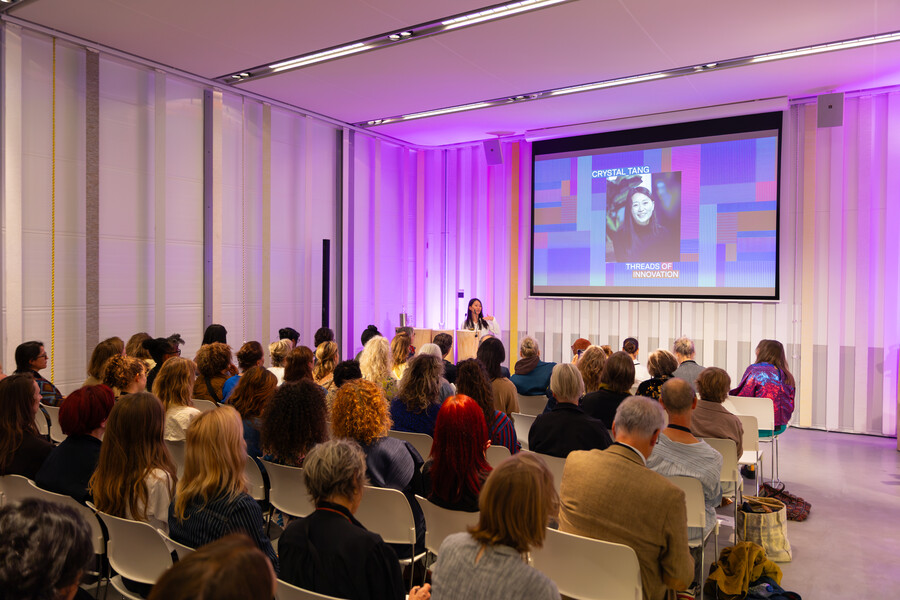
Tang describes architects as conductors. You always need others to bring a piece of music – or a building – to life exactly as you envisioned it. She brings up images of two striking buildings on Amsterdam’s P.C. Hooftstraat, designed by her practice. Although constructed from stone, metal and glass, their references to textiles are unmistakable.
‘Look,’ she says, pointing to one of the images. ‘You can clearly recognise a woven structure in this façade.’ She moves on to the windows. ‘And these,’ she adds cheerfully, ‘look like a zip.’
The architecture practice develops the concept and creates the design, but a building like this would be impossible without the specialists involved. ‘Just think of bending the metal for those zip-like windows. I found that quite exciting: we had come up with the idea, but was it actually possible? The answer was yes. For me, this is a great example of how collaboration and experimentation can lead to something new, both in design and in practice.’
Tang cycles along P.C. Hooftstraat every day on her way to and from work. ‘It’s incredibly rewarding to see how the shop is used day after day, and how much people enjoy the design.’
A network of meanings
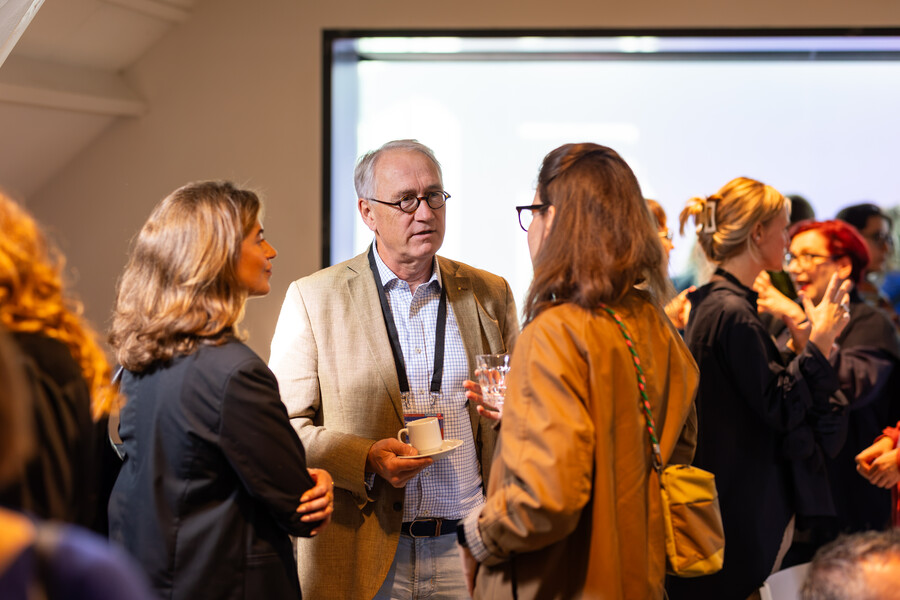
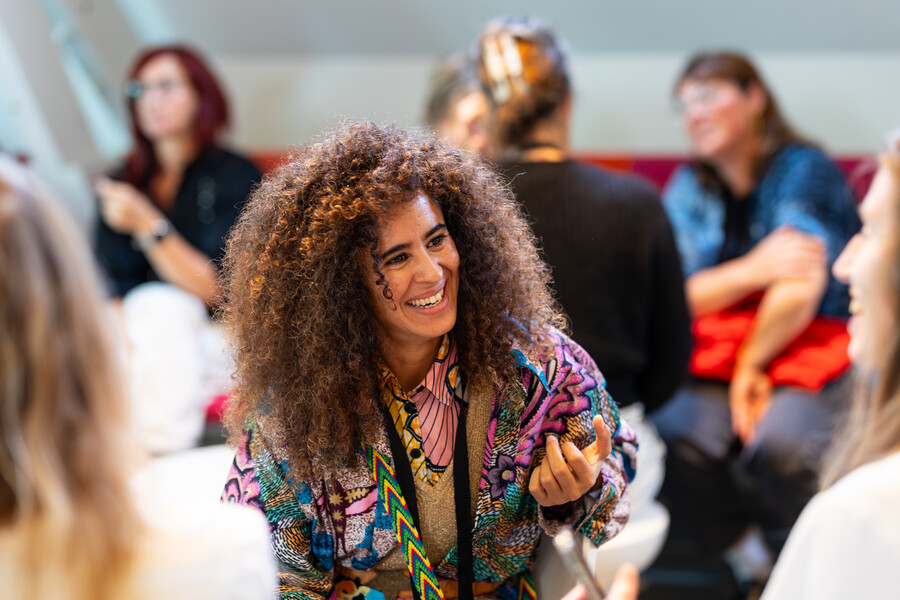
A short break for coffee and biscuits gives participants a welcome opportunity to reflect on the speakers’ different perspectives. Artists, manufacturers, researchers and students exchange ideas around tables, on sofas and while standing together.
A lecturer at a university of applied sciences says she was particularly struck by Jessica Hemmings’ idea of textiles as a medium filled with stories. A designer sitting beside her nods in agreement. ‘Textiles have so many layers. Take my textile installations, for example. Of course, they convey an artistic message, but the craft of weaving tells its own story, too.’
Nog zo’n verrassend perspectief komt van de vijfde keynotespreker, Amanda Pinatih, curator design hedendaagse kunst bij het Stedelijk Museum Amsterdam en promovenda aan de Vrije Universiteit Amsterdam. Zij pleit voor een open blik op textiel, zonder het in een categorie (zoals ‘kunst’ of ‘erfgoed’) te willen stoppen. Er zit namelijk zoveel meer in dan dat ene label. Als voorbeeld wijst Pinatih op het werk ‘Don’t tell me kwaku anansi’ van Anya Paintsil, waarin ambachtelijke technieken, haar van familieleden van de kunstenaar, kindertijdherinneringen en het bevragen van de manier waarop verhalen worden doorverteld, samenkomen.
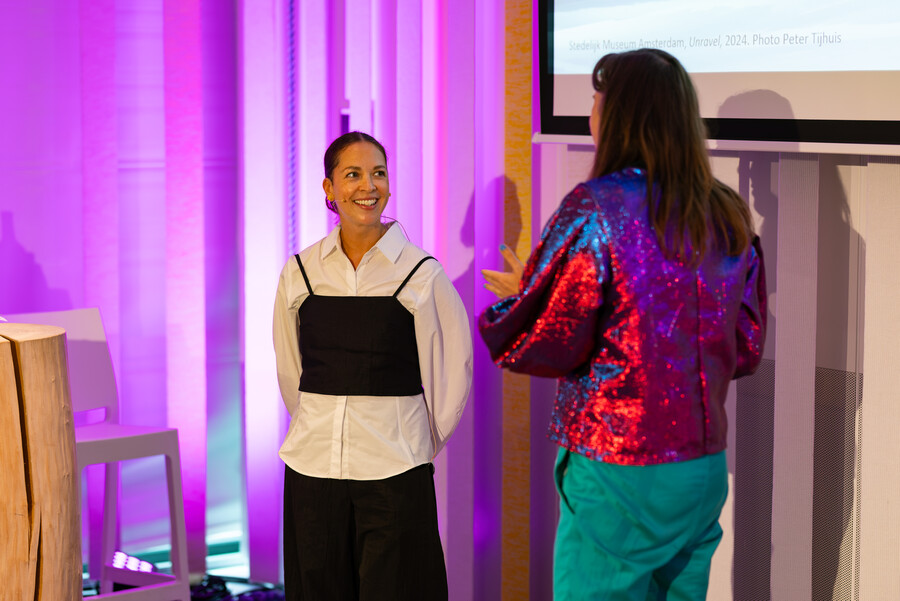
Another unexpected perspective comes from the fifth keynote speaker, Amanda Pinatih, curator of design and contemporary art at the Stedelijk Museum Amsterdam and a PhD candidate at Vrije Universiteit Amsterdam. She advocates an open-minded approach to textiles, without confining them to categories such as ‘art’ or ‘heritage’. There is far more to textiles than any single label can convey.
As an example, Pinatih discusses Don’t tell me kwaku anansi by Anya Paintsil. The work brings together traditional craft techniques, hair belonging to the artist’s family members, childhood memories and questions about how stories are passed down through generations.
The researcher argues that doing justice to this complexity means viewing textile works as a network of meanings rather than reducing them to a single category. A fellow researcher in the audience agrees that this approach shifts how we understand textiles.
‘When you look at textiles in this way, beyond those boundaries, a whole range of possibilities opens up.’ Pinatih concluded her talk with a statement that resonated with the audience: ‘The key to innovation is refusing categories.’ A powerful perspective, in the researcher’s view.
Craft as an anchor
What does the future hold? According to trend forecaster Lidewij Edelkoort, we are increasingly returning to raw materials, craftsmanship, flowing lines and organic, natural colours.
‘So much is happening in the world right now. We are picking up the pieces and putting them back together. We draw materials and inspiration from ancient cultures and historical discoveries. We are returning to something more rustic and less organised.’
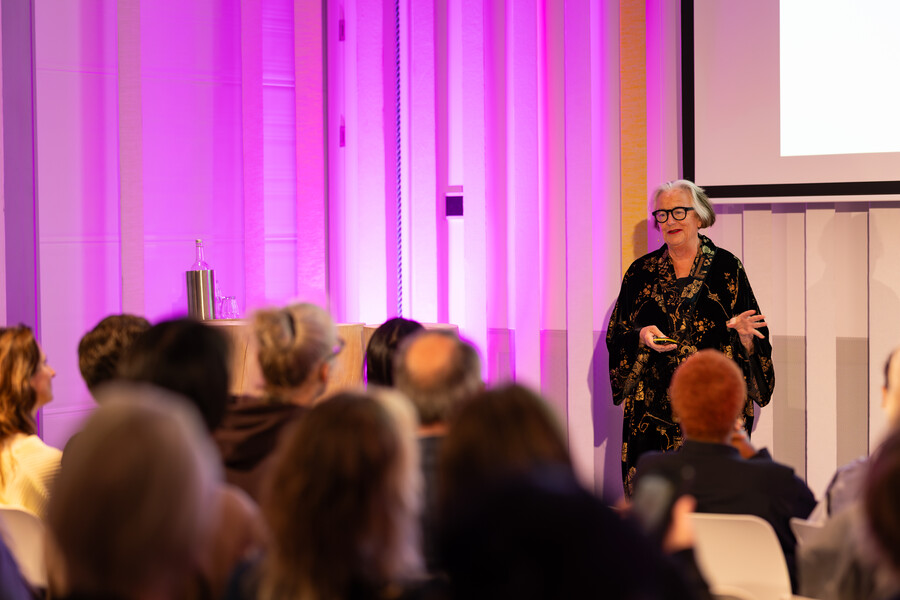
Edelkoort expects the appropriation of elements from other cultures to become less prevalent. ‘If we do use visual languages or techniques from other cultures, we will work with local craftspeople and pay them for their contributions,’ she says. ‘The ego will become less important, and overproduction will decline.’
In a world being shaken to its foundations, we are returning to what we already know. ‘Handwork and craftsmanship are a saving grace. Amid all this change, they are our constant, something we can hold on to.’
A celebratory touch
A generous lunch buffet fills everyone’s stomachs and offers time to reflect on the speakers’ words. The hour-long break also provides an opportunity to meet fellow participants and explore the museum. Many symposium attendees are keen to do just that, as this edition has a celebratory touch: TextielLab is marking its 25th anniversary.
One of the highlights is the exhibition MENS <3 MACHINE, which attracts plenty of visitors during the symposium. Among them is a fashion student watching a video in which a broadly smiling Stef Miero, weaving product developer, explains that he was not particularly skilled at weaving 25 years ago.
Did artist Peter Struycken realise that at the time? ‘No,’ he explains. ‘We embarked on the research together.’
The student smiles. ‘You just have to get started: learn, experiment, fail, refine and try again. Here at TextielLab, I can see what that can lead to.’
Overlapping worlds
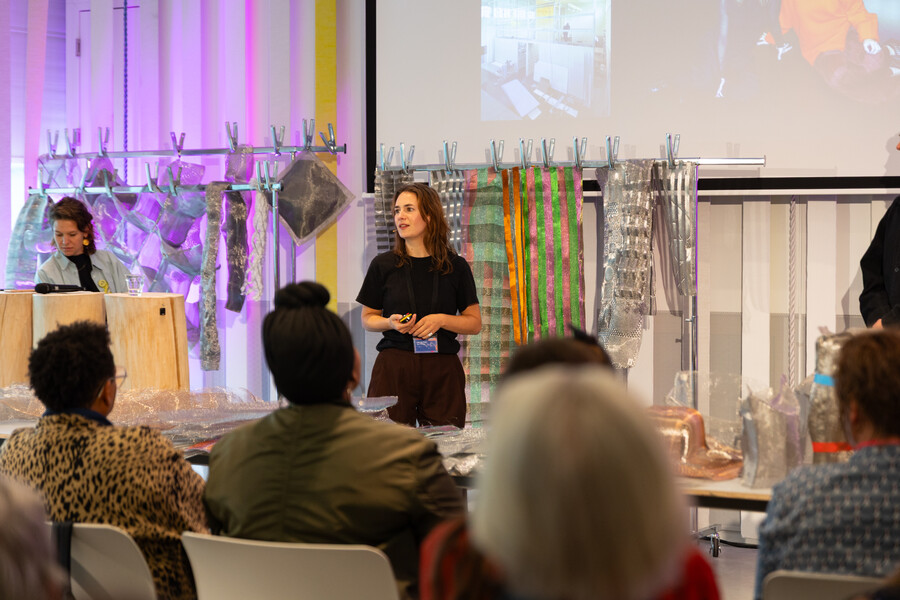
Dense, glossy, undulating structures with geometric forms. A more open, silver- and copper-coloured construction that can be bent and folded as desired. When an architect and two graphic designers explore the possibilities of weaving with metal, the results offer surprising insights. That much becomes clear at Threads of Innovation.
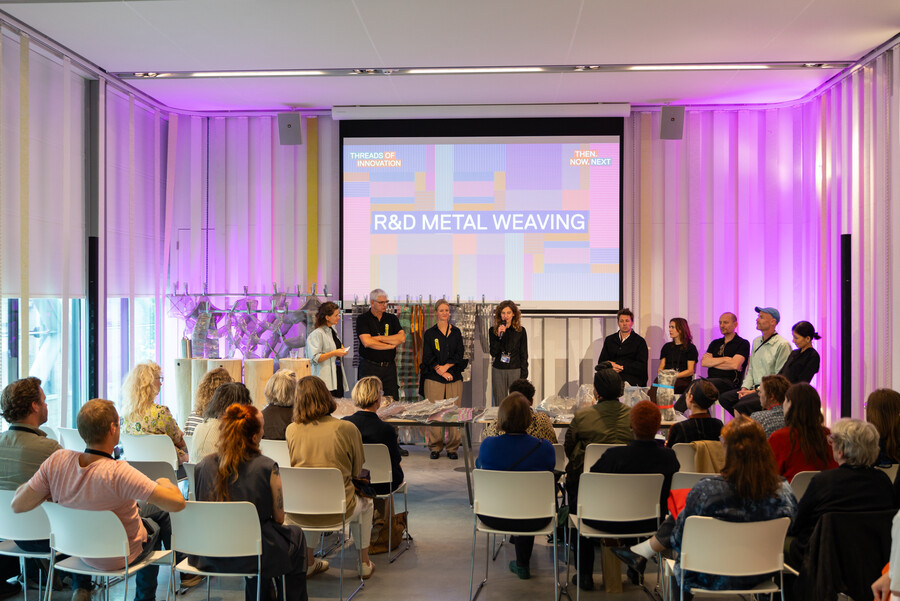
The afternoon programme includes a series of breakout sessions, one of which explores the ongoing R&D programme in metal weaving. TextielLab launched an open call for this programme last year. Among the contributors are Tomas Dirrix (Atelier Tomas Dirrix) and Loes van Esch (Team Thursday), who present a fascinating process of searching, testing and experimenting.
Their work is still a work in progress, but already highly inspiring, says one participant. She designs jewellery herself. ‘In this research, the worlds of metal and textiles overlap. That alone is exciting,’ she says, running her fingers over a sample. ‘Seeing, hearing and feeling this really gets my mind going.’
Making music on the loom
Another breakout session takes place amid the thumping, humming and rustling of the weaving machines in TextielLab. Wearing headphones, participants in Threads of Innovation listen to three perspectives on the lab’s 25-year history.
One speaker is Peter Dornier of the weaving machine manufacturer Lindauer Dornier, who explains what the collaboration with TextielLab has meant for him and his company.
‘It is only here, in TextielLab, that you truly see what a weaving machine can be. It is not a production device, but a musical instrument. As a conductor, you can use it to create the most innovative and diverse compositions,’ he says. ‘There are not many places where people push the boundaries of our machines, but this is one of them. That is what makes this collaboration so interesting.’
Beside him, product developer Miero nods enthusiastically. ‘What we can do now is extraordinary compared with 25 years ago. And we will continue to push those boundaries, together with our clients, artists, residents and interns.’
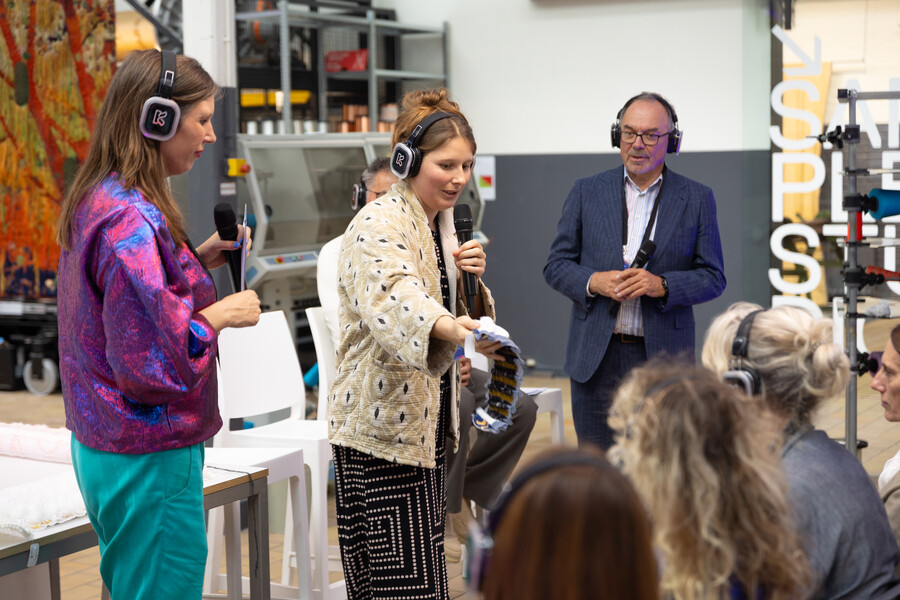
Artist Alexandra Ross knows this from experience. She spent eight months as a resident at TextielLab, where she worked on Smart Textiles. She connected different textile works using wiring and sensors. The work responds to the presence of people by emitting pulses of light. It is a living, innovative system inspired by nature.
‘I enjoy pushing the boundaries of the loom. You can do that here. Nobody told me, “That won’t work.” The attitude was: give it a go and see what happens.’
Food for thought
The many layers of textiles. The wealth of stories waiting to be told. And the power of experimentation and collaboration. As music drifts up through the stairwell of TextielMuseum, these are the ideas circulating in the minds of visitors to Threads of Innovation.
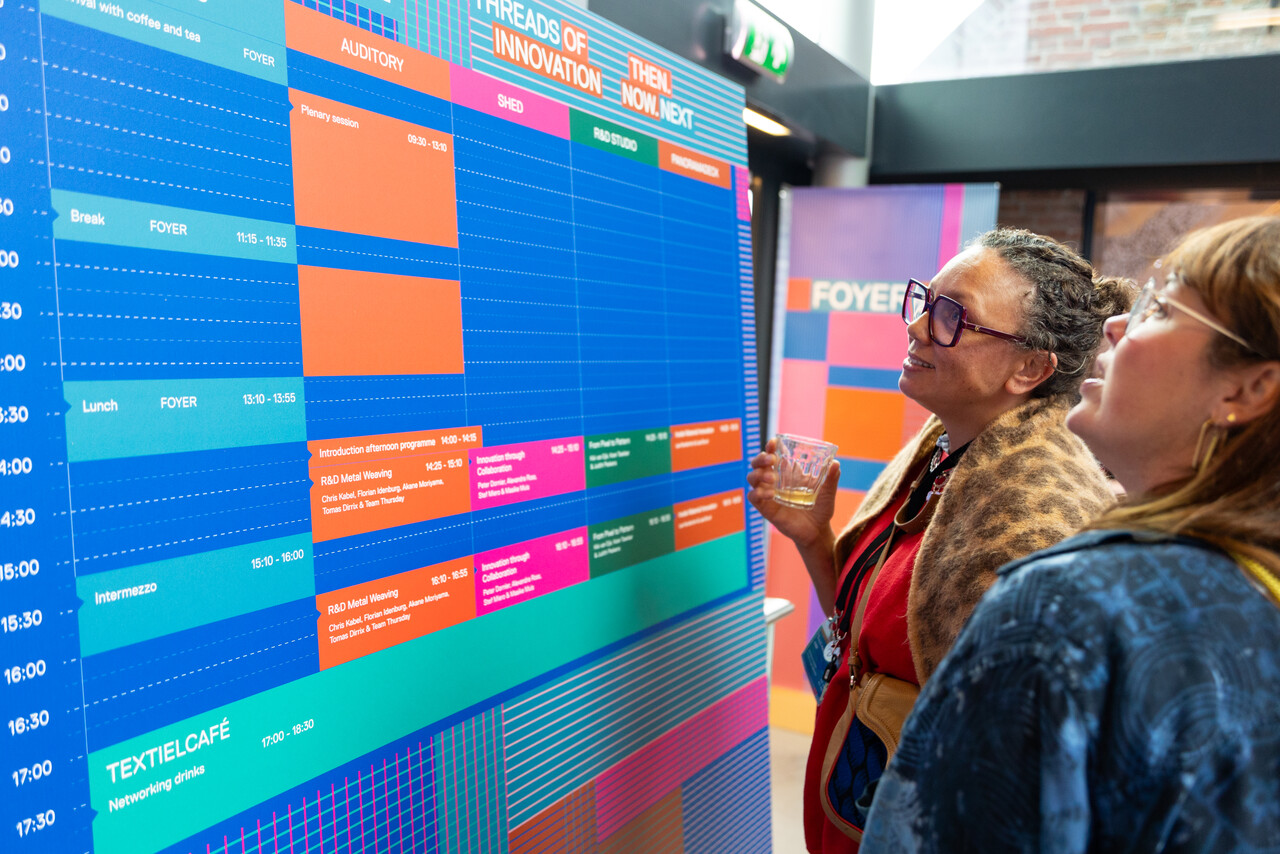
One idea connects them all: to move forward, you have to get to work. Make, test, experiment and try again. Explore and push boundaries together. Only then can genuine innovation emerge, keeping our field alive, both now and in the future.
Just look at how TextielLab has evolved over the past 25 years. The symposium brought a wide range of perspectives on textiles and experimentation into focus. Or, as one of the makers in the audience put it: ‘I would love to attend a day like this every year. It makes me think, and that is essential if we want to move forward and keep innovating – both as artists and as a creative, innovative sector.’
The programme also featured contributions from Lea Nordström of Kvadrat Innovation Lab, Florian Idenburg of SO–IL, Chris Kabel, Akane Moriyama, Kiki van Eijk, Koen Taselaar, materials adviser Lise Brunt, Head of Research and Development Noortje van den Elzen and product developer Judith Peskens.
Written by Iris van den Boezem
Photography by Jelle Verheijke. Find more photos from the day here.
Stay tuned
Where designers collaborate on innovation, there is a lot of news to get. Subscribe to the newsletter and get automatic updates on special projects, discoveries, events and open calls.
Share with friends


